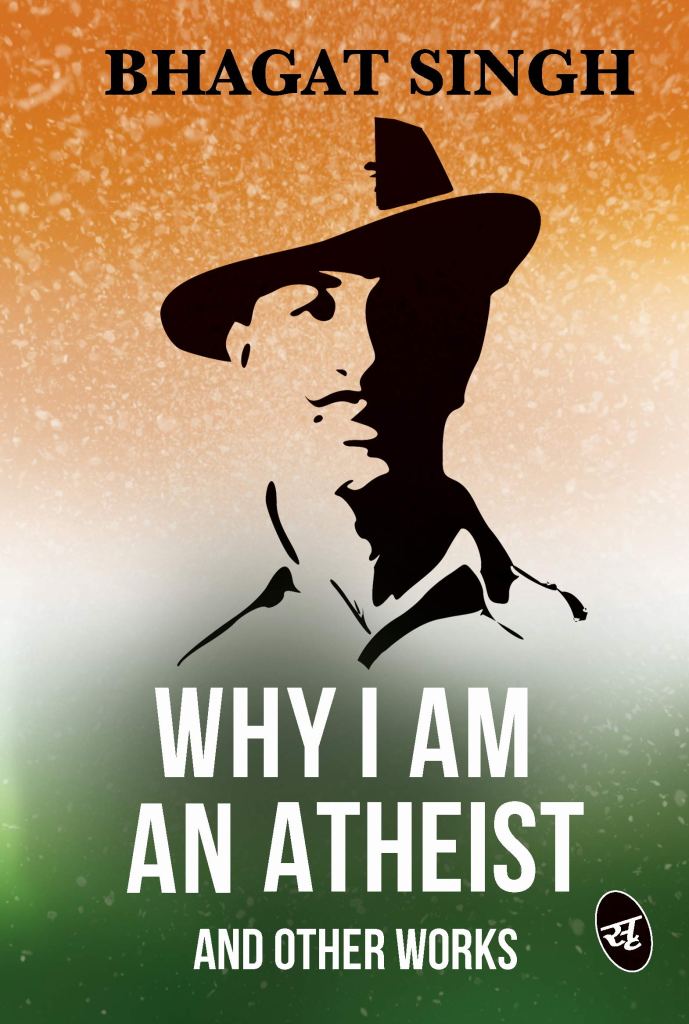
A book is a collection of essays, letters, or articles written by revolutionary Bhagat Singh on various occasions referring or replying to different peoples or agencies. Most of the parts in the book are written when he was in jail. A special one or two-liner by Bhagat Singh, before each chapter, is really good to read and absorb in life.
The first and important one, an essay “Why I am an atheist?” is a response written for his religious friends, who claim he is an atheist because of vanity and thinking he is an autocrat. In it, he precisely and point-wise, with examples explained “why he chose to be an atheist and doesn’t believe in the existence of an omnipotent, omnipresent, and omniscient God?”, and it’s not because of vanity most precisely Ahankar. It shows his strong knowledge, study, and reading of various subjects, with clear thoughts and straightforwardness about his thinking, beliefs, and life. It is a good book to read thoughts and writings in it will help us think differently and clear our confusion, if any.
Other letters, essays available in the book, are :When his father requesting a chance to prove his innocence and trying to prove it, he wrote a letter to him, explaining his decision not to defend himself in Saunder’s murder case.
A letter, written to close friend and comrade Sukhdev. When Sukhdev misunderstood his decision and accused him of weakness, he wrote a letter to explain his thinking and point of view.
A Red pamphlet, leaflet threw by Bhagat Singh and B Dutt in the assembly after bombings in assembly. It claimed responsibility for bombings, explained superly their motives and demands behind it and their thoughts on human life and the future.
A copy of the statement of Bhagat Singh and BK Dutt after got arrested for bombings in assembly. They explained, in brief, the motive of bombings, purposefully why and where they threw bombs in assembly, and explained point-wise and with historical events every act with full responsibility. They stated their motive was not to kill somebody but to make noise so the government will hear them. They explained motive and reason, with major points like Viceroy’s views endorsed, Practical protest, Attack on the institution, No hope for labor, Bomb needed, No personal grudge, No miracle, etc.
In prison, Bhagat Singh and Batukeshwar Dutt started a hunger strike for better treatment of political prisoners, so he wrote a letter to the Home member of the government of India, and it includes a list of demands. Demands, like a better diet at least same as that of European prisoners, no force to do hard and undignified work, books with writing materials, daily newspaper, special ward, better clothes, toilet necessities, etc.
Prisoners suspended the hunger strike after assurance, but the Government resorted to some delay, tried to evade it, and disciplinary action was taken against participants. So, Bhagat Singh wrote this letter to the home member, through the special magistrate, telling about the thought of reiterating hunger strike demands. In it through various points, he explained their demands and action taken against comrades.
Bhagat Singh and BK Dutt jointly wrote an inspiring message for the students, attending the second Punjab students conference under the presidentship of SC Bose, asking them to fight for the nation wholeheartedly by spreading a revolutionary message.
Bhagat Singh wrote this letter responding to Sukhdev’s letter, in which he wrote he would be willing to kill himself if he was sentenced to life imprisonment instead of execution. He motivated him by reminding him how he contested against him when he said, in some cases, suicide is justifiable, and inspired him with more justification and explanation.
After the second hunger strike, fulfillment of demands was assured to prisoners, but some minor ones were sidelined. To defy this, Bhagat Singh refused to attend court, and newspapers claimed it is the boycott of the British courts, so he wrote a letter to the magistrate, explaining the motive of the boycott and intention to rejoin the proceedings once all demands fulfilled and complaints got resolved.
In the face of recurrent and active hunger strikes by the accused in the Lahore conspiracy case, the government of India passed an ordinance called LCC ordinance number 3 of 1930, allowing the establishment of a special tribunal, compromising three High Court judges, who could carry on the court proceedings even in the absence of the accused, and the Governor-general of India supported the ordinance, so Bhagat Singh wrote a letter as a response it. In a letter, he wrote the government authorities always tried to misrepresent them, and they need to counter it and clear their stand.
A letter with a complete list of the books, requesting school friend Jaidev Gupta to collect the books from the library and send those to him through Kulvir. The letter reflects his love for reading and various subjects.
The presiding judge lost temper during the proceedings of the Lahore conspiracy case and handcuffed the accused, and sent them back to Jail. In retaliation, Bhagat Singh requested the judge be removed. On 21st June, instead of the next senior judge, sympathetic towards the accused, Justice Hilton, a party to the previous order, replaced the presiding judge. So, in the request of his removal, Bhagat Singh wrote a letter to Commissioner.
Bhagat Singh wrote his feelings to comrade friend B.K.Dutt, after the death sentence pronounced to him, and transportation for life-sentenced to B.K.Dutt. Show the world that the revolutionaries not only die for their ideals but can face every calamity, he wrote.
To inspire and motivate young political workers to take part in the revolution and think about the future with the program’s formation Bhagat Singh wrote a letter marking them. After his execution, it was published in a mutilated form, carefully deleting all the references to the Soviet Union, Marx, Lenin, and the communist party. Subsequently, the Government of India published it in one of its secret reports in 1936.
On 23 December 1930, the Governor of Punjab got slightly injured, and one man died when he was leaving the university hall Lahore after the convocation address, Hari Kishan fired at him. In the trial, his defense counsel argued that he had no intention to kill the Governor, and he only wanted to warn. Bhagat Singh opposed this line of defense and wrote a letter to one of his friends telling how revolutionary cases should be conducted!. This letter contains his objections and thought on the line of defense in this case and thought on what stand lawyers should take in defense of political cases.
Bhagat Singh penned down the introduction, on his friend Lala Ram Saran Das’s request to do it, for his collection of poems, “The Dreamland.” It includes his political views with some details of his friend’s life, work, and thinking.
Bhagat Singh’s last letter, a petition to expedite the order of his execution. In a letter marked to the Punjab Governor, he wrote, we are war prisoners and should be treated like that only because the main charge against them was of having waged war against H.M.King George and requested don’t hang us, shoot us. He cleared his thought behind demand and explained it briefly.
Some lines in a book that clears his thinking are “They can kill me, but they cannot kill my ideas. They can crush my body, but they will not be able to crush my spirit”, “The sword of revolution is sharpened on the whetting stone if ideas”, “Revolution is an inalienable right of Some lines in the book show his revolutionary thinking and knowledge, like “They can kill me, but they cannot kill my ideas. They can crush my body, but they will not be able to crush my spirit.” “The sword of revolution is sharpened on the whetting stone of ideas.” “Revolution is an inalienable right of mankind, and freedom is an imperishable birthright of all.” “If the deaf is to hear, then sound has to be very loud.” “I never had any desire to defend myself, and never did I seriously think about it.” “I will climb the gallows gladly and show to the world as to how bravely the revolutionaries can sacrifice themselves for the cause.” “My strength is the strength of the oppressed; my courage is the courage of desperation.” ”Lovers, lunatics, and poets are made of the same stuff.” “I am such a lunatic that I am free even in jail.”
This This book is a clear picture of Bhagat Singh’s thought process and thinking. Justifying his every action and motive behind it. A must-read book for the knowledge and information about him and the revolutionary’s condition in jail, and know about their role in freedom fight and molestation for it.
 Chetan Nikam