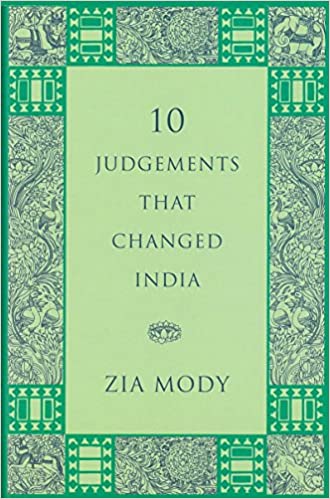
10 Judgements That Changed India, a well-written book by Zia Mody, a collection of ten critical and influential judgments passed by the Supreme Court of India, which transformed democracy and redefined the daily life of all Indians through their rights and laws.
Zia Mody is born with the law and legal language in her blood, the daughter of Soli Sorabjee, Attorney-General for India, who continued her father’s professional legacy. She collected in the book country’s 10 most influential cases from 1947 to 2010 the cases that affected every person of the country directly or indirectly by defining their rights and duties.
The 10 cases briefly explained in the book are:
1. Kesavananda Bharati Vs. State of Kerala (1973).
Basic Instinct: A landmark in modern constitutional jurisprudence.
Propagating the basic structure, doctrine as a safeguard against the usurpation of the Constitution.
2. Maneka Gandhi Vs. Union of India (1978).
Life, Uninterrupted: The Supreme Court’s chance at redemption.
Expanding the meaning of the “right to life” under the Constitution of India.
3. Mohammed Ahmed Khan Vs. Shah Bano Begum (1985).
Whose law is it anyway?: A flashpoint in religious fundamentalism.
Questioning the sanctity of personal religious laws and bringing the debate on a Uniform Civil Code to the forefront of the national discourse.
4. Olga Tellis Vs. Bombay Municipal Corporation (1985).
Home on the range: The emergence of ‘second generation rights’ like housing.
Further expanding the meaning of the ‘right to life ‘ and including second-generation rights.
5. Union carbide corporation Vs. Union of India (1989).
Justice delayed: The loss through law.
Steps on the road to recovery: decisions relating to the Bhopal gas tragedy.
6. Indra Sawhney Vs. Union of India (1992).
‘No, I am more backward than you are!’: The discourse on reservations.
Delivering the decision relating to the constitutionality of reservations under the Constitution of India.
8. Supreme court advocates-on-record Association Vs. Union of India (1993).
Courting liberty: Independence of the judiciary as envisaged by the Constitution of India.
Settling the power of the Supreme court of India to make judicial appointments.
9. Vishaka Vs. the State of Rajasthan (1997).
All in a day’s work: Sexual harassment at the workplace.
Innovating jurisprudence to prevent sexual harassment at the workplace.
10. Aruna Ramachandra Shanbaug Vs. Union of India (2011).
Killing me softly: The euthanasia debate in India.
Accepting passive euthanasia as being constitutional.
The book provides brief information on the Indian national’s constitutional basic rights. It clarifies the terms PIL, writ petition, suo moto, number of judges on the bench, how they pass the decision, with its importance. It also gives information on the 6 (7-1) freedoms that countryman has. Those freedoms are :
1) The freedom of speech and expression.
2) The freedom to assemble peaceably and without arms.3) The freedom to form associations or unions.
4) The freedom to move freely throughout the territory of India.
5) The freedom to reside and settle in any part of the territory of India.
6) The freedom to practice any profession or to carry on any occupation, trade, or business.
7) The deleted one, the freedom to acquire hold and dispose of the property.
The book also explains the right to life and personal liberty under article 21
Rights of prisoners: including protection from handcuffing, without adequate reasons access to a transcript of the judgment, and facilities to exercise his right to appeal against his conviction, the right to treatment with dignity and humanity, the right of any undertrial to be released from custody if the police fail to file a charge sheet within the period prescribed by law, for protection from custodial violence and protection against public hanging.
Environmental rights: including the right to a humane and healthy environment, the right to sustainable development protection from pollution hazards due to the use of pesticides, and the right to live without undue affection of air, water, and the environment.
Other rights: including the right to live with human dignity, including access to nutrition, clothing, and shelter, the right to free education of children up to the age of 14 years, the right to live livelihood, protection of one’s reputation, access to just and humane conditions of work, protection of the health and strength of workers and maternity relief.
The book explains in detail the history of the cases, relevant international cases, their reference and judgments, previous decisions of lower courts, decisions given by the supreme court, its impact on the constitution and most important people of India, flaws in decisions or misuse of it, legal loopholes, about the counteraction taken by Parliament to overrule the decisions and laws passed for against it ( example Shah Bano Begum case ), the role of jurisdiction and parliament in law-making and it’s implementation (example Vishaka case), power tussle of elected versus nominated representatives and debate on who is at a higher position, action to gain more strength and reduce the power of others, use of court and judge by an elected representative in the Government.
Some cases are examples, where the court and parliament came face to face, the role of ministers to dominate the rulings of courts, how they tried to use the courts for self or government benefits, interference of government in the independence of court after an emergency, amendment in the constitution. Aruna Shanbaug’s case is a great example of humanity shown by the hospital and staff over more than 35 years. Bhopal’s case shows the value of life in the country. Every case opens a new knowledge box for readers.
The language used in the book to explain the cases is easy and understandable, except for the Keshava Bharati case. A useful book for law professionals and students and a must-read one to get basic information on constitutional rights and freedoms. The book helps to understand how Jurisdiction ensures those are not getting violated.
 Chetan Nikam